The mesophotic zone is home to habitats that are essential for populations of sessile benthic species such as gorgonians, red coral, and black coral, as well as for numerous fish species. These habitats form “animal forests” that play a crucial role in the structure and functioning of marine ecosystems. At the same time, commercial and recreational fishing are exerting increasing pressure on these areas, and their impacts remain insufficiently assessed, although they are likely to be significant.
CANOPY project offers a multidisciplinary approach aimed at:
- Mapping the mesophotic zone and its habitats,
- assessing the conservation status of sessile benthic populations, particularly forests of gorgonians, red coral, and black coral,
- characterizing the fish communities living there,
- quantifying the impact of commercial and recreational fishing activities,
- studying the biogeochemical and physical environment influencing these ecosystems
- communicatating with the public and decision-makers to integrate the mesophotic zone into marine protection and conservation policies.
The ultimate goal is to support the implementation of appropriate conservation measures, in accordance with public policy guidelines, while incorporating the three-dimensional aspects of the environment and addressing climate-related challenges, in order to preserve these refuge habitats and ensure the long-term survival of populations of engineer species such as gorgonians, as well as their associated fish communities.
Why "CANOPY" ?
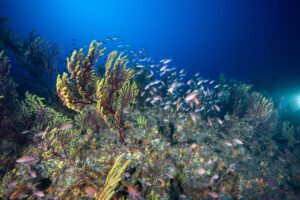
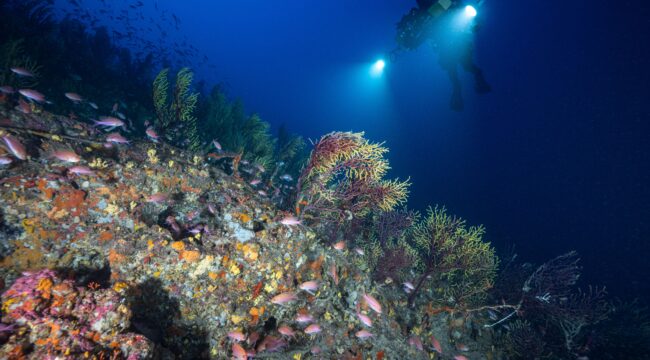
The mesophotic zone remains largely unseen and little understood. Yet observations made at these depths reveal rich and structured ecosystems, far from being a uniform or barren environment. The images and data collected from these depths reveal complex, inhabited, and dynamic ecosystems. Certain tree-like benthic organisms, such as gorgonians, red coral, and black coral, grow in sufficient densities to form true three-dimensional landscapes, comparable to terrestrial forests, and to alter environmental parameters to create unique habitats.
Although they belong to the animal kingdom, these formations are referred to by the scientific community as “marine animal forests.” Much like terrestrial forests, they provide shelter, resources, and breeding grounds for numerous species, thereby playing a major role in maintaining and enriching marine biodiversity. You won’t find birds, monkeys, or insects there, but rather a teeming marine life: fish, crustaceans, mollusks, corals, sponges, and bryozoans, all dependent on the presence of these marine animal forests.
CANOPY project takes its name from this analogy: it refers to a marine canopy, still largely unexplored, whose understanding is essential to grasping how these deep-sea ecosystems function.